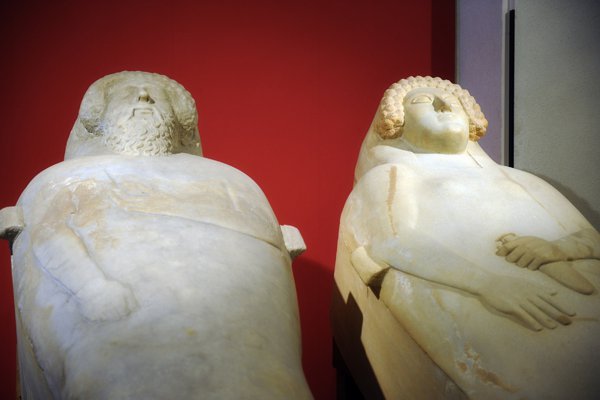
Archaeological Museum of Cádiz
It's a must visit. Include pieces dating to the Lower Paleolithic and other unusual and unique such as Anthropomorphic Phoenician Sarcophagi, bronzes dedicated to Merkart-Hercules or the halls of the Roman world, with many reminders and ceramics.
Located in the Plaza de Mina in XIX century building. Their hours are from 14:30 H to 20:30 on Tuesdays, Wednesday to Saturday from 9:00 to 20:30 and Sunday and holidays from 9:00 to 14:30. Tel: 956 203368. Entry is free for citizens of the European Union and 1.5 euros for the rest of the world.
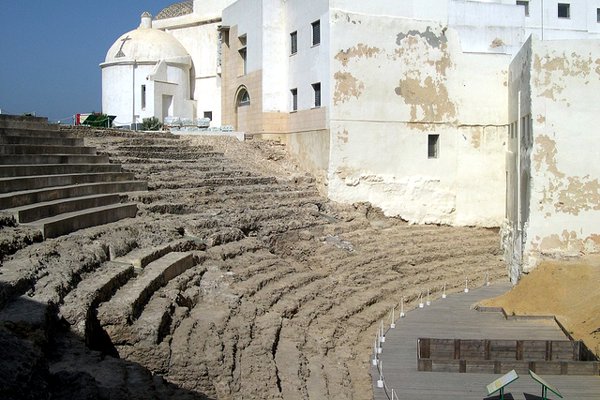
The Roman Theatre
It was discovered in 1980 and is considered one of the largest buildings of its kind in Spain. It's the end of the first century BC., And was built by Balbo.
The Roman Theatre is located in the neighborhood of El Pópulo, along the Campo del Sur, just meters from the cathedral.
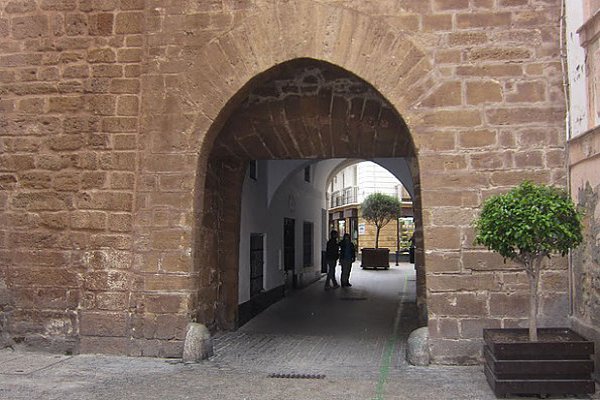
The Pópulo district
The Pópulo district is the oldest of Cádiz. Three arches are preserved were the gateway to the medieval walled town. Their names are: "Arco del Pópulo", "Arco del la Rosa" and "Arco del Blanco". It was, geographically, the first settlement and the place where they lived Phoenicians, Carthaginians, Romans and Arabs throughout history. Also noteworthy in this neighborhood architectural works such as the Casa del Almirante, La casa del Obispo, or the City Hall of the capital in the Plaza de San Juan de Dios.
It is located just outside the Old Town, between City Hall and the Cathedral.
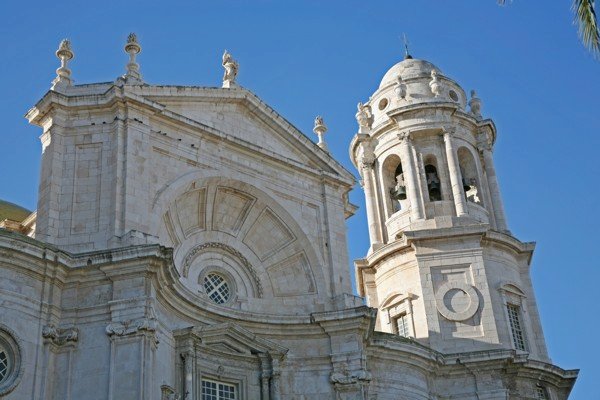
The Cathedral of Cadiz
Cadiz Cathedral, designed by Vicente Acero, was built between 1722 and 1838. Also called "New Cathedral". It visitation schedule for both the enclosure to the west tower, whose visit advised by the breathtaking views it offers. He appreciates the change of style and tastes of individual architects who intervened mix explains: Baroque, Rococo and Neoclassical. It also highlights the variety of materials used in its construction.
Cadiz Cathedral is located in the square to which it gives name, near the Plaza San Juan de Dios.
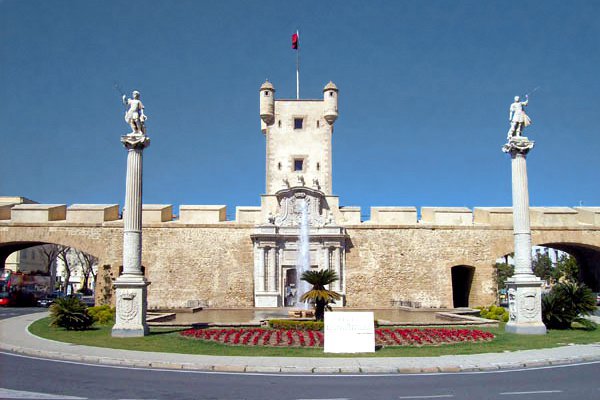
The Puertas de Tierra
Designed by architect and academic Torcuato Cayon, with delicate carved marble cover. It is part of the ambitious plan of defense against pirates and enemies of the crown, covering the perimeter of the peninsula, formed by walls dotted with forts and bastions. The arches belong to a reform of the fifties, made by architect Antonio Sanchez Esteve. Separate the two Cadiz, Cadiz old, walled, and the new reclaimed land sea.
In the Tower of the Puertas de Tierra can visit a Virtual works, a thematic virtual Cadiz S. Civil and Military XVIII. This route can be made from Monday to Friday from 10-18 hours. Saturdays from 10-17 hours , and Sunday from 10-15 hours. Price: Audiovisual 3D on Military Cadiz and visit the Tower: € 4. Civil Cadiz - Virtual tour and visit to Torreon 4 €. Special bonus for both visits: € 6.
Las Puertas de Tierra establish the boundary between the old city and extramural
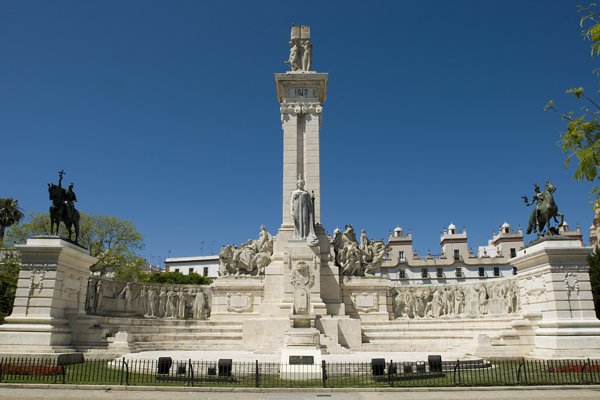
Monument to the Courts from 1812
The monument commemorates the centennial of the 1812 Constitution and the French site to the city. The work is the architect Modesto López Otero and sculptor Aniceto Marinas, began in 1912 and ended in 1929.
Other attractions in the square where the Monument to the Cortes of 1812 are the County and the house of the 4 towers, a beautiful example of the famous watchtowers that have given fame to Cadiz. In the seventeenth and eighteenth, Cadiz merchants were made to build a tower as an observatory to monitor maritime traffic. Cadiz still has more than a hundred of these watchtowers.
The Monument to the Courts from 1812 is located in the Plaza of Spain, next to the county council.
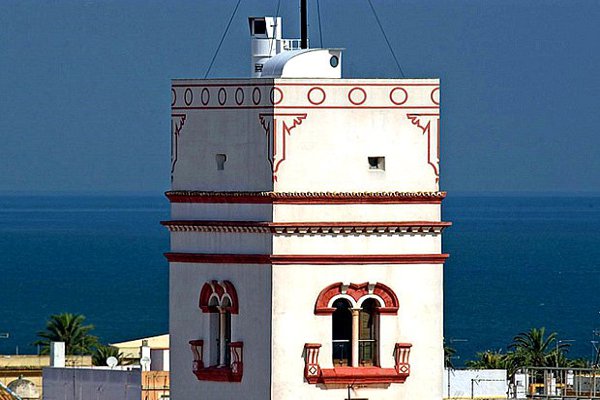
Tavira Tower
The watchtowers, trade and prosperity witnesses that lit Cadiz in s. XVIII, are very characteristic of the city. They were used to monitor the arrival at the port of ships from America loaded with precious goods overseas.
The Tavira Tower was appointed official watchtower of Cadiz, being the highest point of the city, which is 45 meters above sea level in the center of the old town. Currently houses the camera obscura, a device that projects real-time images of the city Aeras on a mobile screen, through a complex set of mirrors.
The Torre Tavira is located near the Market Square.
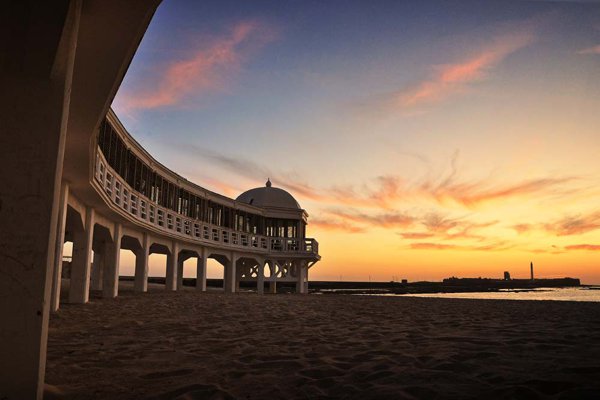
The Caleta Beach
In Caleta beach find several points of interest. Firstly the Balneario de la Palma, a beautiful wellness building whose arms seem to want to embrace the sea, its sunsets are hardly surmountable. Second, we have access to Castle of Santa Catalina and Castle of San Sebastian. The latter is located on a small island where tradition says was the temple of Kronos, and is grounded with a boardwalk, allowing that is not isolated at high tide. The walk to the Castle of San Sebastian is an absolutely recommended.
The Caleta Beach is located in the traditional district of La Viña.
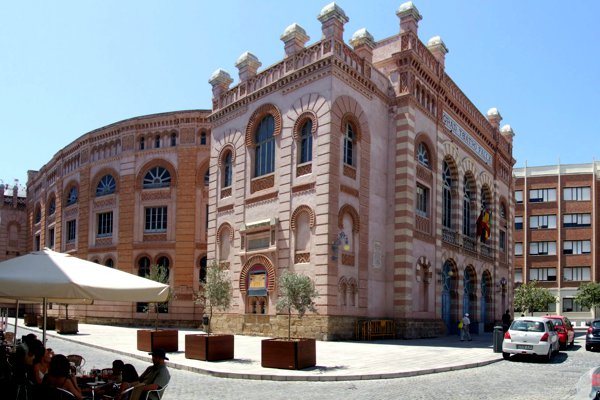
Falla Grand Theater
The Gran Teatro Falla (Falla Grand Theater) was built between 1884 and 1905 on the site of the old Grand Theater of Cadiz, which burnt down in 1881. Built The red brick exterior and Moorish style, gives its main façade Fragela Square, also highlighting the richness and colorful interior dominated also by the Spanish Moorish style. The roof is covered by a large canvas depicting an allegory of Paradise. The stage is huge, 25.5 meters deep and 18 wide.
The many spectacles that it hosts throughout the year include the official contest of clusters of Carnival of Cadiz, one of the greatest attractions of the carnival.
The Theatre is located at Fragela Square.